
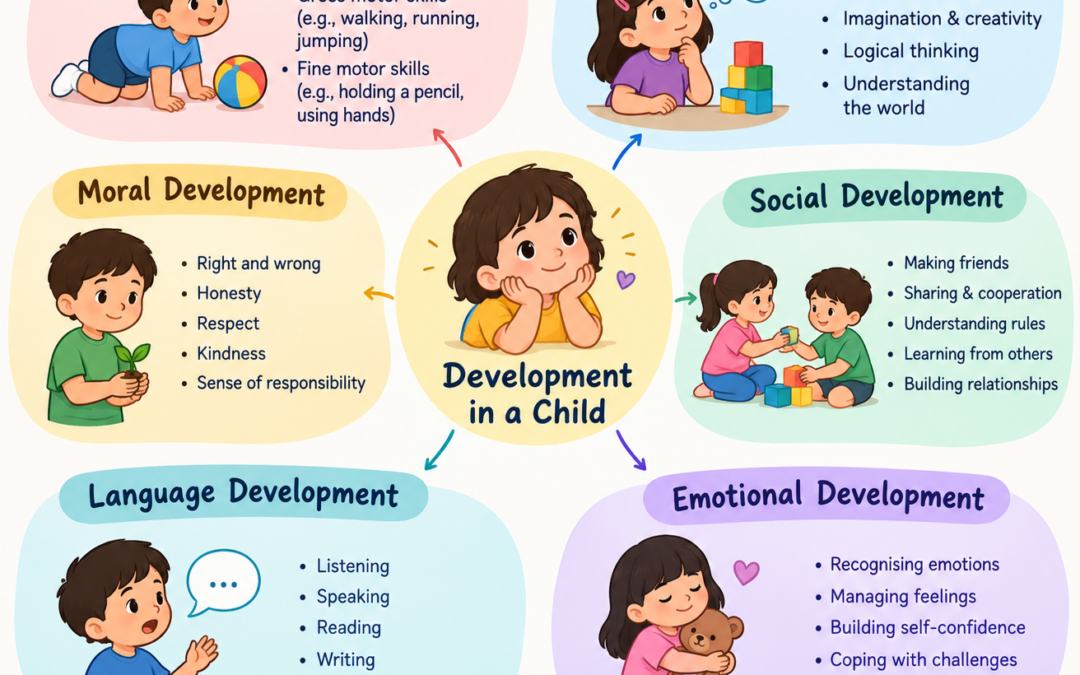
Child development is the process through which a child grows and changes physically, mentally, emotionally, socially, and linguistically from birth to adulthood. It includes the development of the body, brain, thinking abilities, communication skills, emotions, and relationships with others. Every child develops at their own pace, and development is influenced by heredity, environment, nutrition, family, education, and social experiences. Physical development includes changes in height, strength, movement, and coordination. Cognitive development refers to the growth of thinking, memory, understanding, and problem-solving abilities. Language development helps children understand words, communicate their needs, and express their thoughts. Emotional development enables children to recognise and manage their feelings, while social development helps them build relationships, share, cooperate, and understand others.
Parents and teachers play an important role in supporting child development by providing love, care, encouragement, nutritious food, opportunities to play, and a safe learning environment. Children learn through observation, exploration, interaction, and everyday experiences. Activities such as storytelling, drawing, playing games, asking questions, and interacting with other children support different areas of development. It is also important to remember that development does not happen at the same speed for every child. Some children may develop certain skills earlier than others, and individual differences are normal. Parents and teachers should observe children’s progress, appreciate their efforts, and provide support according to their needs. Understanding child development helps adults choose appropriate teaching methods, recognise children’s strengths, and support their overall well-being.
Main Areas of Child Development
- Physical development: Growth of the body, muscles, and movement skills.
- Cognitive development: Thinking, memory, reasoning, and problem-solving.