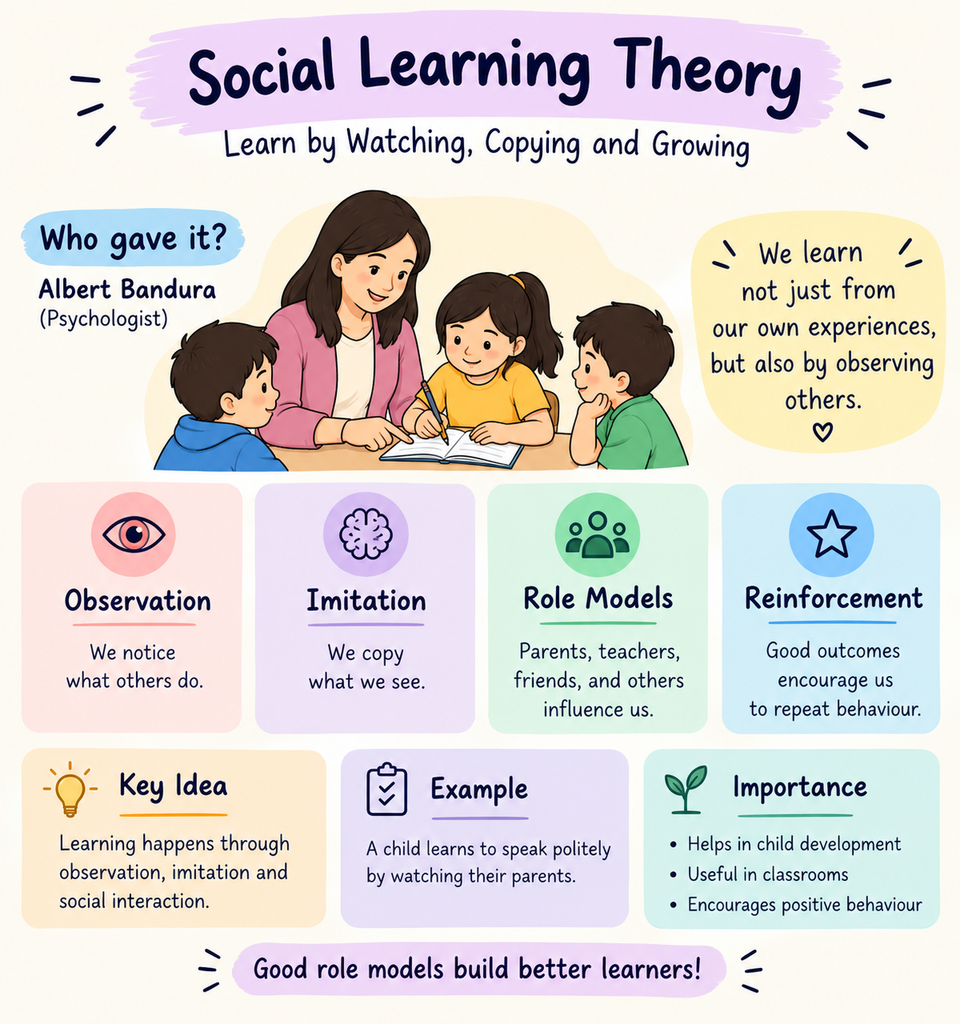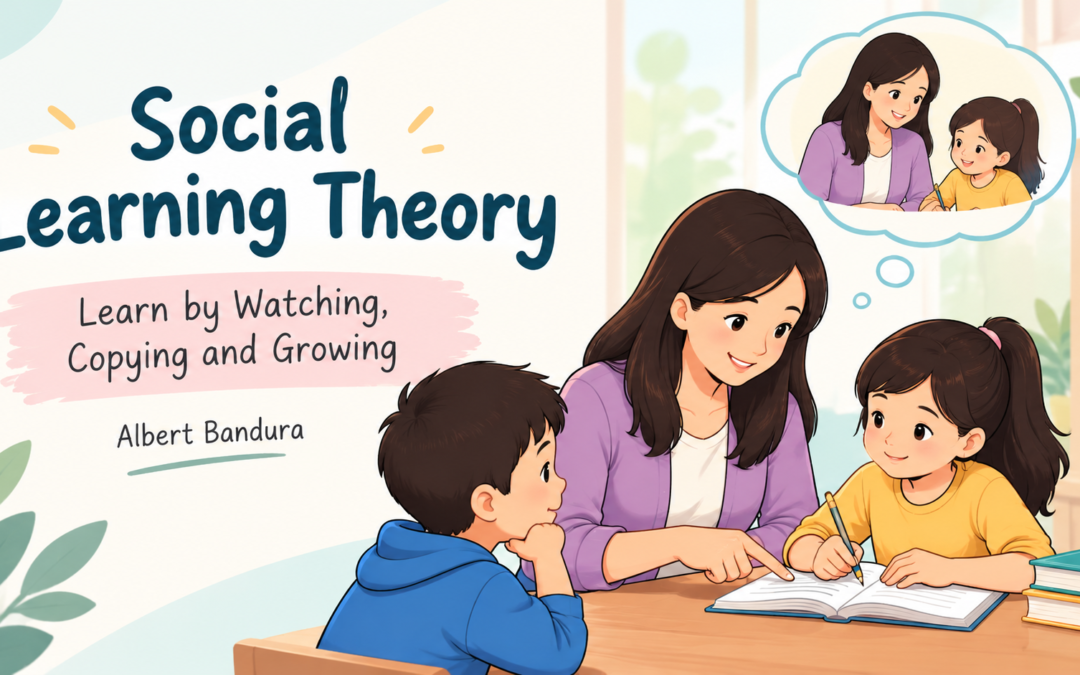
Social Learning Theory is an important theory of educational psychology developed by the famous psychologist Albert Bandura. This theory explains how people learn new behaviours, habits, skills, and attitudes by observing other people. According to Bandura, learning does not always require direct experience because people can learn simply by watching others. Children often learn by observing their parents, teachers, friends, and classmates. The person whose behaviour is observed is called a model. Learning by observing others is known as observational learning, while copying another person’s behaviour is called imitation. Modelling is also an important concept in this theory because learners may adopt the behaviour of people they observe.
According to Albert Bandura, observational learning involves four important processes: attention, retention, reproduction, and motivation. Attention means observing the behaviour carefully. Retention means remembering the behaviour that has been observed. Reproduction means trying to perform the learned behaviour, while motivation means having a reason or willingness to perform it. For example, when a student observes a teacher solving a mathematics problem, the student pays attention to the steps, remembers them, tries to solve a similar problem, and feels motivated to practise. These four processes help explain how learning takes place through observation.
Important Points
read more
Another important concept of Social Learning Theory is reinforcement. Reinforcement can encourage people to repeat certain behaviours. Direct reinforcement occurs when a person receives a reward for their own actions. Vicarious reinforcement occurs when a person observes someone else receiving a reward and learns from that experience. For example, when a child sees a classmate being praised for helping others, the child may also begin helping classmates. Bandura’s famous Bobo Doll Experiment, conducted in the early 1960s, demonstrated that children could imitate behaviours they observed in adults. The experiment highlighted the influence of role models on children’s behaviour.