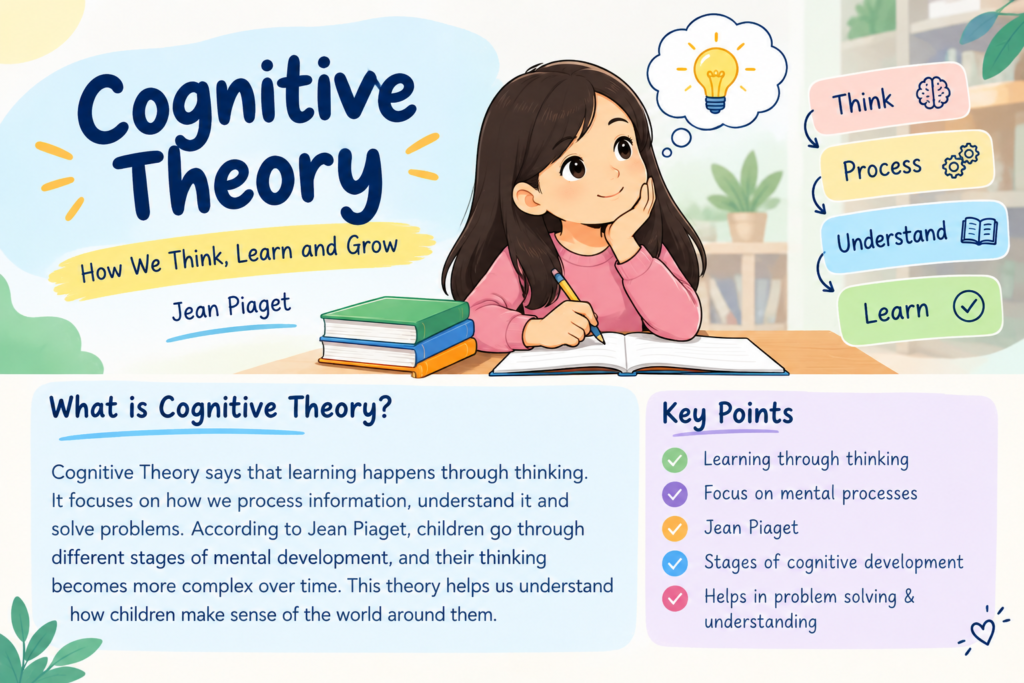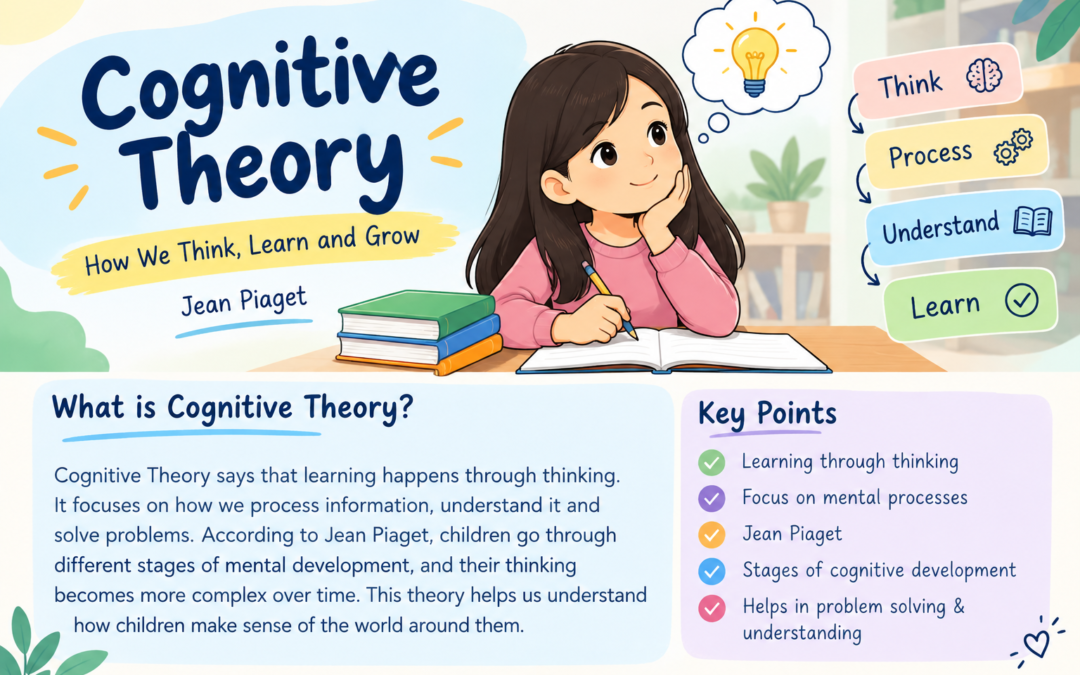
Cognitive Theory is an important theory in educational psychology that explains how people learn through thinking, understanding, memory, attention, and problem-solving. The word cognitive refers to mental processes. According to this theory, learners do not simply receive information; they actively process it, connect it with their previous knowledge, and develop their own understanding. Jean Piaget, Jerome Bruner, and Ulric Neisser are important psychologists associated with cognitive psychology and cognitive approaches to learning. For example, when a teacher explains a new concept, students understand it better when they connect it with something they have already learned or experienced.
Read More
Cognitive Theory focuses on how learners receive, organise, store, and recall information. Attention helps learners focus on important information, while memory helps them retain and use what they have learned. Thinking and reasoning help students understand relationships between ideas, and problem-solving enables them to find solutions to different situations. For example, a child learning mathematics may use previously learned addition skills to understand multiplication. Teachers can apply Cognitive Theory by using diagrams, examples, activities, questions, and problem-solving tasks. They should encourage students to understand concepts instead of simply memorising facts. In conclusion, Cognitive Theory explains that learning is an active mental process in which understanding, memory, thinking, and previous knowledge play important roles.